


SPECIFICATIONS
| Model | Scale | Total Capacity (L) | Working Capacity (L) | Blade Speed (m/s) | Motor Power (kW) | Dimensions L×W×H (mm) |
|---|---|---|---|---|---|---|
| FRM-10 | Lab | 13 | 3–9 | 26 | 3 | 1400 × 570 × 1520 |
| FRM-30 | Lab | 33 | 9–23 | 26 | 7.5 | 1490 × 580 × 1660 |
| FRM-100 | Pilot | 121 | 33–77 | 29 | 22 | 1705 × 900 × 1500 |
| FRM-200 | Pilot | 225 | 67–175 | 28 | 37 | 2328 × 1200 × 1830 |
| FRM-300 | Pilot | 348 | 96–220 | 25 | 55 | 2376 × 1241 × 2166 |
| FRM-500 | Production | 618 | 170–397 | 29 | 90 | 2724 × 1308 × 2400 |
| FRM-1000 | Production | 1206 | 339–790 | 28 | 132 | 1880 × 3100 × 2150 |
| FRM-2000 | Production | 2265 | 639–1491 | 30 | 250 | 3700 × 1350 × 2800 |
| FRM-3000 | Production | 3150 | 897–2093 | 29 | 315 | 3900 × 1680 × 3000 |
Standard blade linear speed as listed per model. Custom configurations available up to 100 m/s.
OPERATING PRINCIPLE
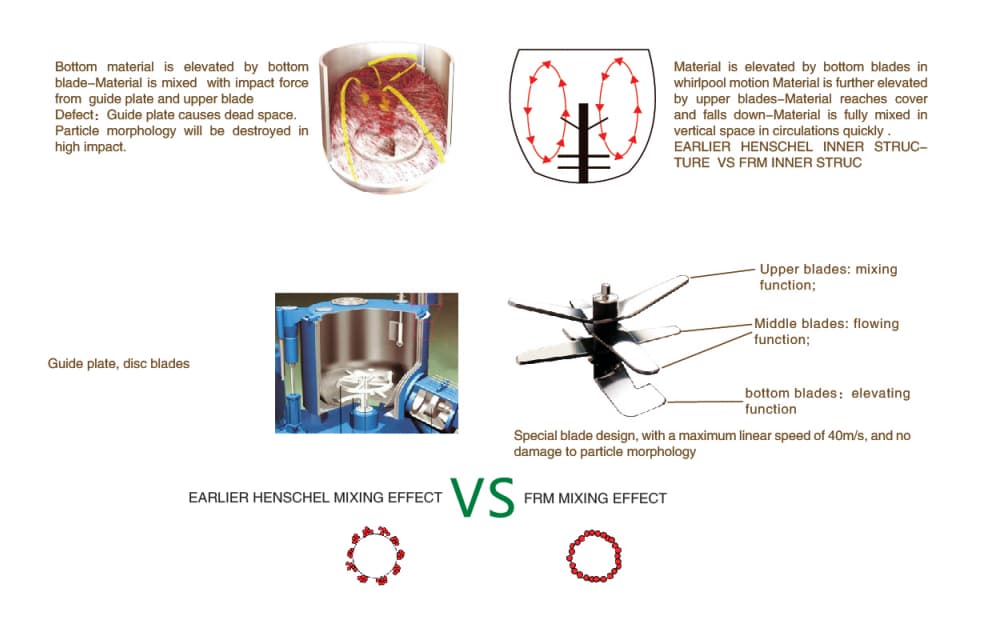
A three-tier blade assembly rotates inside the vertical sealed chamber:
- Upper blades — V-shaped, mixing function
- Middle blades — straight, flow function
- Lower blades — large-radius angled, elevating function
Peripheral powder rises along the chamber wall.
Central powder descends simultaneously.
This opposing vertical circulation generates velocity and directional differentials between particles — micro-level homogenization driven entirely by high-speed inter-particle friction, no external impact force required.
Guide plates are eliminated from the chamber design.
Without direct high-velocity particle-wall impact, particle morphology is preserved across all operating speeds — including high-nickel NCA and NMC 811 formulations where sphericity is critical.
Standard blade linear speed up to 40 m/s; custom configurations available to 100 m/s.
XPC multi-V-belt drive with dual-end pulley support delivers low vibration at high RPM.
Product discharges through a pneumatic curved-plug valve with O-ring cylinder seal —
zero leakage across repeated open-close cycles, no residual powder at the discharge port.
KEY FEATURES
- Guide-plate-free chamber
No direct particle collision, no dead zones — particle morphology preserved at any operating speed - Three-tier blade assembly (V-type / straight / large-radius angled)
Standard blade linear speed: up to 40 m/s
Custom configuration: up to 100 m/s - Dual-seal spindle system
Upper seal — compressed air purge, isolates powder from shaft
Lower seal — heat-resistant oil with 3-layer fluoroelastomer lip seals
Spindle service life extended 3–5× vs earlier designs - Integrated cooling jacket + real-time temperature sensor
Full batch temperature monitoring; critical for LiOH-containing lines where process temperature must stay below 35 °C - Pulse-jet exhaust filter
Automatic post-batch self-cleaning via membrane pulse valve
Optional folded cartridge for rapid pressure equalization and lower in-vessel gas pressure - Pneumatic hopper-type discharge
O-ring cylinder seal — zero residual accumulation at discharge port
Linear rail slide for easy maintenance access - Chamber inner surface
Stainless steel standard; optional tungsten carbide (WC) spray coating for abrasive or adhesion-prone materials - Safety interlock
Lid physically blocked from opening until spindle reaches full stop
EXPERIMENT RESULTS
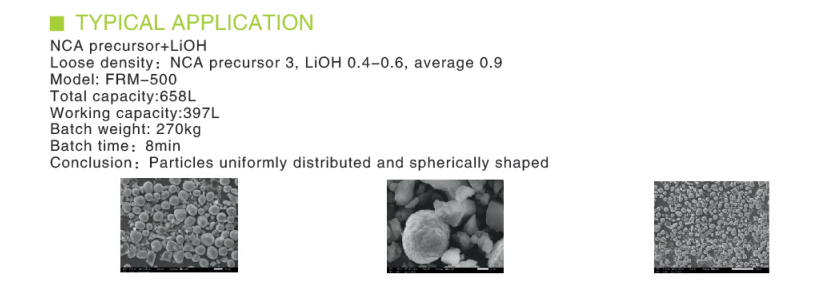
NCA Precursor + LiOH Blending — FRM-500
| Feed materials | NCA precursor (bulk density 3 g/cm³) + LiOH (bulk density 0.4–0.6 g/cm³) |
| Blend bulk density | 0.9 g/cm³ (±0.2 g/cm³) |
| Particle size | D50 5–20 µm, D90 < 70 µm |
| Batch size | 300 kg/batch |
| Mixing time | 8–10 min |
| Result | Particles uniformly distributed and spherically shaped. Confirmed by SEM. |
APPLICATIONS
- Lithium battery cathode materials
NCA, NMC 811, 523, 622 precursor + LiOH blending; temperature-controlled mixing to protect particle sphericity in high-nickel formulations - Sodium-ion battery materials
Oxide and polyanionic precursor dry blending for cathode sintering preparation - Carbon anode materials
Graphite and carbon black dry blending; bulk density improvement confirmed in production lines - Advanced ceramics
Homogeneous multicomponent powder blending before pressing and sintering - Pharmaceutical powders
Dry API and excipient micro-level blending; no contamination from guide plates or dead-zone accumulation
PRODUCT GALLERY
Enquiry
Tell us your material, target particle size, and throughput. We will advise on
model selection and run a trial on your own powder before you commit to equipment.
Yibin Andy Wei — Application Engineer
Email: [email protected]
LinkedIn: Yibin Andy Wei
WhatsApp: +1 380 900 2442