
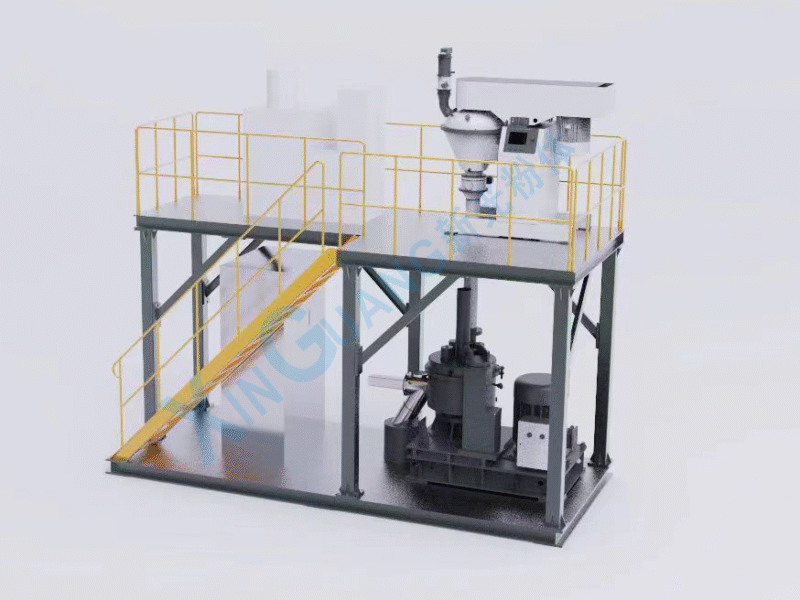
LC-50 Liquid Coating System trial — artificial graphite pitch coating run
Artificial graphite powder for fast-charge lithium-ion anodes was carbon-coated using the LC-50 Liquid Coating System with a low-temperature pitch at a dosage of 3–6 wt%. Conventional dry-route coating at the customer’s facility produced non-uniform wall thickness and carried high energy overhead. In this trial, pitch was heated to 120–150°C, atomized, and delivered continuously via spray nozzle at 2–15 g/s onto graphite particles in active circulation, forming a uniform, controllable carbon shell in a single vessel. The customer conducted downstream performance testing, confirmed all targets were met, and placed a purchase order.
Challenge
Fast-charge graphite anodes operate under high lithium-ion flux during charge cycles. A carbon coating layer is required to stabilize the solid electrolyte interphase and reduce side reactions at the particle surface. For fast-charge applications, that layer must be thin, continuous, and consistent across every particle — local gaps or thick spots degrade rate capability and cycle life directly.
Conventional dry-route coating mixes solid pitch powder with graphite under mechanical force. Wall thickness is difficult to control because pitch distribution depends on particle-to-particle contact rather than liquid coverage. The high softening points of standard pitch grades also demand elevated process temperatures, raising energy costs per batch.
These two constraints — uncontrolled wall thickness and high energy consumption — are the primary pain points for customers scaling up fast-charge anode production.
Solution
The LC-50 Liquid Coating System resolves the dry-route limitations by delivering pitch in an atomized liquid state. Pitch is pre-melted externally and sprayed at a controlled flow rate onto graphite particles circulating inside the coating chamber. Coverage becomes a function of spray parameters rather than mechanical blending — enabling wall thickness that is both uniform and adjustable.
Material
| Parameter | Value |
|---|---|
| Material | Artificial graphite (fast-charge anode grade) |
| Modifier | Low-temperature pitch |
| Pitch dosage (wt% of graphite) | 3–6% |
Equipment
| Parameter | Value |
|---|---|
| System | LC-50 Liquid Coating System |
| Chamber total volume | 122 L |
| Batch processing capacity | ≤60 L |
| Drive motor | 75 kW, variable-frequency controlled |
| Main shaft speed | 987 rpm |
| Spray module operating temperature | 120–150°C |
| Atomized spray rate | 2–15 g/s |
Procedure
The LC-50 was prepared and confirmed at operating temperature before the trial began. Rotor and spray sequences were managed through the integrated PLC and touchscreen control panel.
- Feed: Artificial graphite was manually charged into the coating chamber through the top inlet port.
- Low-speed premix: We set the rotor to low speed to circulate the graphite bed and bring it to a homogeneous, active state before spray introduction.
- Spray coating: With low-speed circulation maintained, we activated the spray module. Pitch pre-heated to 120–150°C was atomized and delivered at 2–15 g/s into the particle stream — liquid contact at particle surfaces begins coating immediately.
- High-speed coating and consolidation: After spray completion, we increased rotor speed. Higher centrifugal force drives the liquid pitch film to spread evenly and bond to each graphite particle under mechanical pressure.
- Discharge: Once the coating cycle was complete, the pneumatically actuated outlet valve was opened and coated graphite was discharged for downstream carbonization.
Achievement
The coated graphite showed a uniform, continuous carbon shell on visual and microscopic inspection. In-chamber spray coating eliminated the bare-patch and thick-spot defects associated with the customer’s previous dry-route process.
The customer proceeded with downstream performance evaluation independently. All fast-charge targets were confirmed met, and the customer subsequently placed a purchase order for the LC-50 system — validating the trial result for their production application.
| Item | Dry-Route Coating (Customer Baseline) | LC-50 Liquid Coating Trial |
|---|---|---|
| Pitch delivery method | Solid blending under mechanical force | Atomized spray at 120–150°C |
| Wall thickness control | Particle-contact dependent — difficult to control | Adjustable via spray rate (2–15 g/s) |
| Energy requirement | High (standard-grade pitch, high softening point) | Reduced (low-temperature pitch) |
| Coating uniformity | Non-uniform; bare patches observed | Uniform, continuous layer confirmed |
| Customer validation | Baseline | All targets met; purchase order placed |
Tags
#ArtificialGraphite #PitchCarbonCoating #FastChargeAnode #LowTemperaturePitch #LithiumIonBattery
#TaixianLC50 #LiquidCoatingSystem #LC50
#InChamberSprayCoating #SingleVesselModification #DryRouteSurfaceModification
#HosokawaAlternative #NETZSCHAlternative #NaraAlternative
#BatteryMaterials #AnodeMaterials #SEIStabilization #EnergyStorage #GraphiteCoating