
Specifications
VSH Series — Standard Models
| Model | Scale | Total Chamber (L) | Effective Volume (L) | Motor Power (kW) | Tip Speed (m/s) |
|---|---|---|---|---|---|
| VSH-0.02 | Lab | 0.17 | 0.02 | 1 | 26.4 |
| VSH-0.3 | Pilot | 3 | 0.3 | 5.5 | 25 |
| VSH-10 | Pilot | 27 | 10 | 30 | 26.4 |
| VSH-30 | Production | 90 | 30 | 55 | 25.4 |
| VSH-100 | Production | 354 | 90–100 | 132 | 33.3 |
Operating Principle
VSH Series — Operating Principle
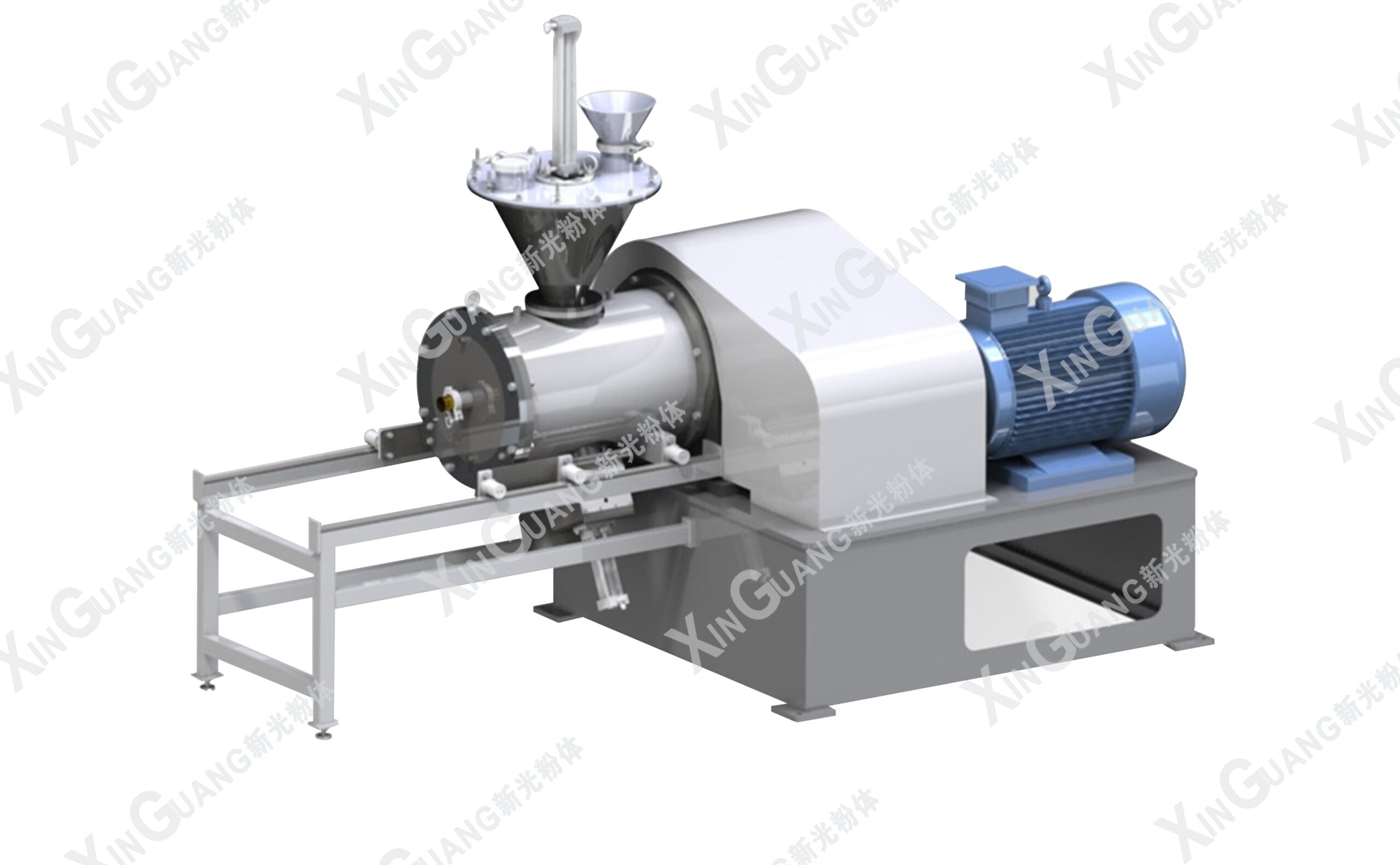
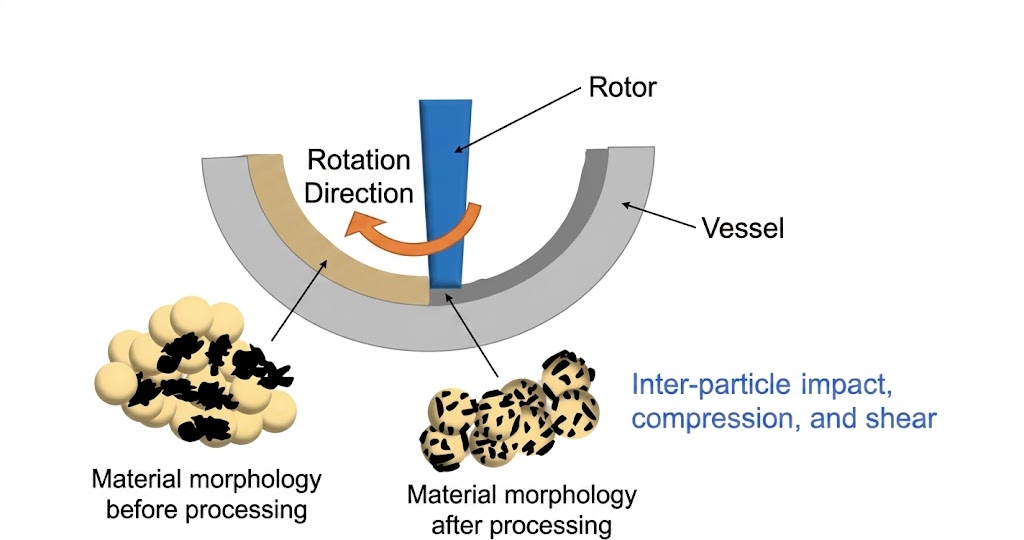
The VSH uses a single high-speed rotor rotating inside a fixed cylindrical chamber. Centrifugal force drives host particles outward against the chamber wall while the rotor blades apply intense shear and compressive impact at tip speeds up to 33 m/s.
Fine coating particles are mechanically embedded onto the host particle surface through repeated high-energy contact events. No binders, solvents, or external heat sources are required; the process relies entirely on mechanical energy transfer between rotor, particles, and chamber wall.
Continuous powder circulation within the chamber distributes coating energy uniformly across all particles in the batch. Processed material is discharged directly after treatment with no post-drying or washing step.
Processing Modes
- Dry Surface Coating — Fine particles such as carbon black, metal oxides, or polymer powders are mechanically bonded onto host particle surfaces under high shear. The result is a thin, uniform coating layer without solvent, binder, or heat input.
- Spheroidization — Repeated shear and impact forces reshape irregular or angular particles into a more spherical morphology. Tap density, powder flowability, and electrode packing efficiency all improve without chemical treatment.
- Multi-Layer Composite Encapsulation — Sequential VSH processing cycles build layered composite shell structures (e.g., core@shell1@shell2) without intermediate discharge, enabling precise multi-component coating architectures for functional powder design.
Key Features
- Tip speed continuously adjustable up to 33 m/s via variable-frequency drive — independent control of coating energy and shear intensity
- All product-contact surfaces in SUS 304 stainless steel; suitable for battery-grade and high-purity material processing
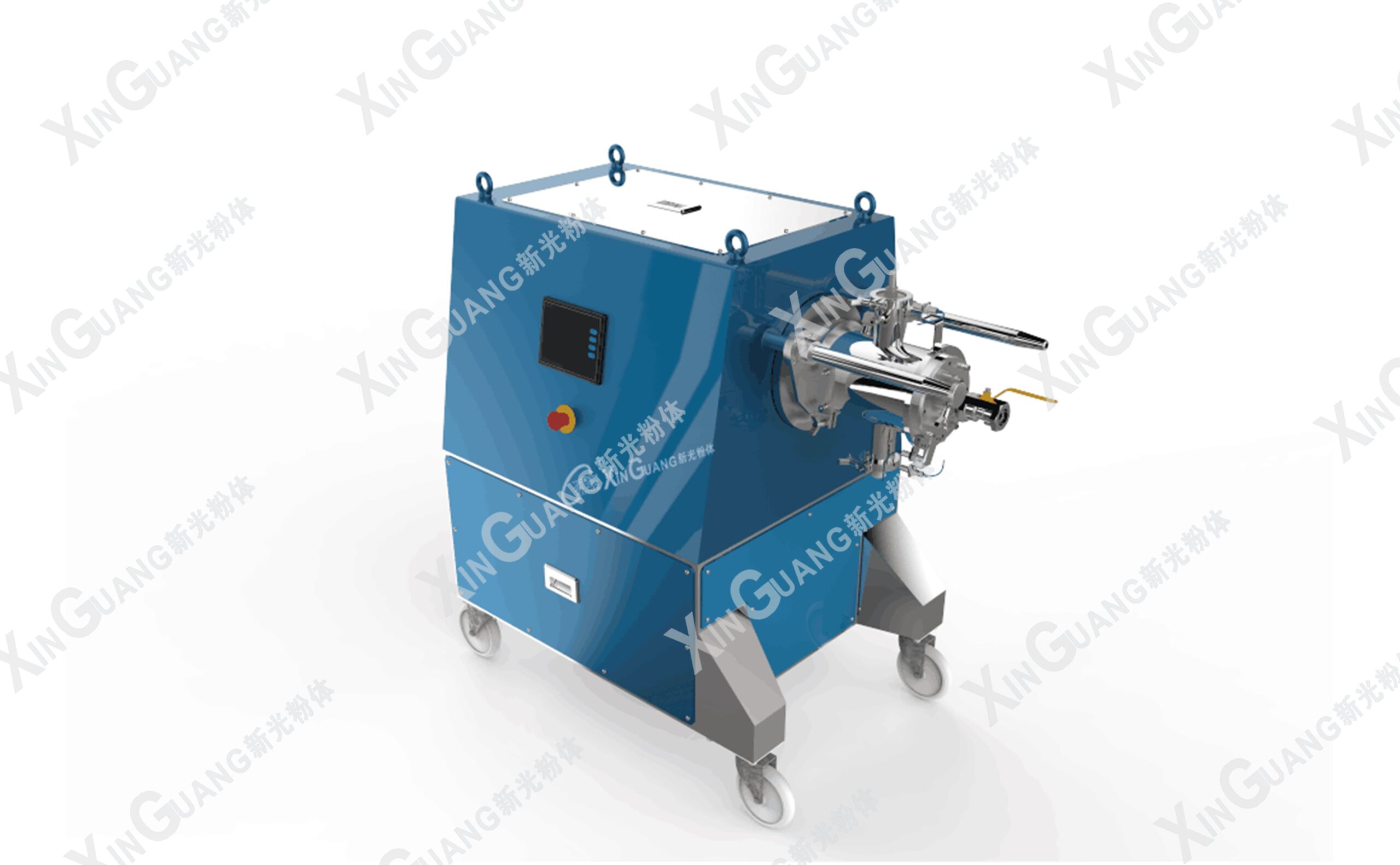
- Five models from 0.02 L to 100 L effective volume — identical chamber geometry across the range enables direct lab-to-production parameter transfer
- Fully solvent-free: no liquid addition, no wastewater, no post-process drying at any scale
- Blade angle configurable at 60° (A-type) or 45° (C-type) to match host particle hardness and target coating thickness
Experiment Results
Carbon Black Coating on LiNiO2
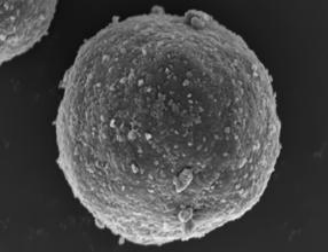
Carbon black (primary particle size approximately 50 nm) was coated onto LiNiO2 cathode particles using the VSH-0.3. SEM imaging confirms a continuous carbon layer covering the host particle surface with no agglomeration of the coating agent.
NMC Ternary Cathode Encapsulation
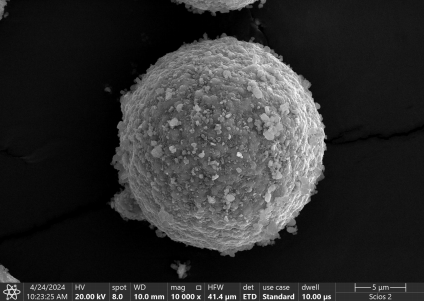
NMC ternary cathode material was encapsulated with a uniform coating layer up to 1 µm thick. SEM cross-section confirms full surface coverage with consistent layer thickness across the particle.
SEM — NMC Ternary Cathode After VSH Encapsulation
Manganese-Based Cathode Spheroidization
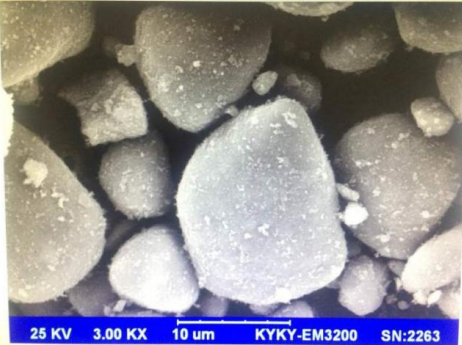
Irregular manganese-based cathode particles were processed through 3 consecutive VSH passes. Particle size distribution and morphology both shifted measurably toward a more spherical form.
| Parameter | Before VSH | After 3 × VSH |
|---|---|---|
| D10 (µm) | 2 | 8 |
| D50 (µm) | 14.3 | 18 |
| D90 (µm) | 35 | 36 |
The increase in D10 from 2 to 8 µm confirms removal of fine irregular fragments; the narrowed span indicates a more uniform, spherical particle population.
SEM — Manganese-Based Cathode: Before and After VSH Spheroidization
Applications
- Battery Cathode Materials — Carbon or oxide surface coating on NMC, LFP, LiNiO2, and manganese-based cathodes for improved conductivity and cycle stability
- Battery Anode Materials — Dry surface modification of graphite, silicon, and composite anode powders for enhanced first-cycle efficiency and rate performance
- Magnetic Powder Composites — Multi-shell encapsulation on FeSi, FeSiAl, and carbonyl iron powders for controlled electromagnetic loss and electrical insulation
- Advanced Ceramic Powders — Oxide or polymer coating for sintering aid application or surface functionalization prior to forming and firing
- Solid-State Electrolyte Composites — Dry surface activation and blending of oxide or sulfide electrolyte particles for composite electrode fabrication
- Specialty Chemical and Pharmaceutical Powders — Dry encapsulation for flow enhancement, controlled release, or compatibility modification without thermal or solvent exposure
Enquiry
Tell us your material, target particle size, and throughput. We will advise on
model selection and run a trial on your own powder before you commit to equipment.
Yibin Andy Wei — Application Engineer
Email: [email protected]
LinkedIn: Yibin Andy Wei
WhatsApp: +1 380 900 2442