
Natural Graphite Anode Processing FAQ
What small-particle natural graphite actually costs at the cell level, and the Taixian equipment chain that fixes the material-level cause behind each one. Every mechanism below is cross-checked against published battery research, not vendor claims alone.
Why small particle size matters — and what it costs if it’s not handled right
Smaller graphite particles mean a shorter lithium diffusion path — that’s what sets how fast a cell can charge. One published kinetic study of graphite anodes, modeling diffusion time from measured Li⁺ diffusion coefficients, found 10 µm graphite able to support roughly 6C fast charge versus about 2C for 20 µm graphite — a theoretical estimate under that model, not a guaranteed spec for every cell design, but directionally clear.
Left as raw flake, small D50 brings two costs: poor packing lowers tap density, and high edge-plane surface area drives excess lithium loss and unstable SEI. Spheroidization and carbon coating exist to keep the fast-charge benefit while removing both costs.
Q1. Our fast-charge cells carry a lithium plating / internal short-circuit / thermal runaway risk — is this a graphite particle problem?
Long diffusion paths and unstable SEI stop lithium from intercalating fast enough under high current, so it plates as metal on the particle surface instead. Plated lithium can grow into dendrites that penetrate the separator — internal short, and in severe cases thermal runaway — a failure path confirmed across multiple independent battery-safety studies.
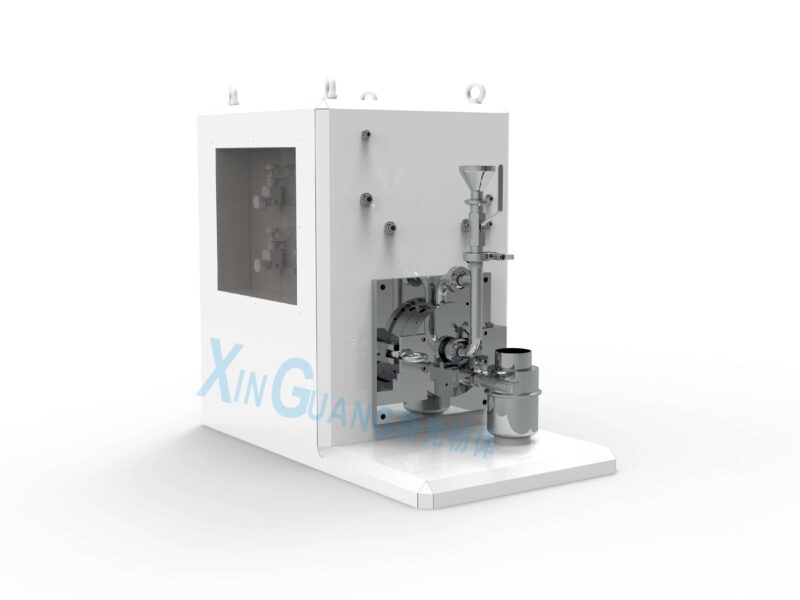
Taixian’s VSN Series Particle Composite Design System or VSH Series Dry Particle Coating and Spheroidization System shortens the diffusion path by rounding flake particles. The VCH Series High-Shear Conical Mixer + VS Series Mechanofusion System + VCJ Series High-Temperature Pitch Coating Furnace — pre-mix, mechanical fusion, and high-temperature carbonization (up to 700°C material temperature, 900°C chamber) — build a more stable carbon-coated surface for fast-charge current.
Q2. Our cells aren’t hitting the volumetric energy density we need from natural graphite — what’s actually limiting it?
Irregular flake particles pack poorly, so tap density stays low. Tap density sets the ceiling on how dense the electrode gets after calendering, and that compaction density is what actually drives volumetric energy density.
The VSN Series Particle Composite Design System rounds flake edges at the highest tip speed in the Taixian lineup — best circularity, smaller batches. The VSH Series Dry Particle Coating and Spheroidization System runs the same shaping principle a touch slower but scales to 100 L production. Either way, tap density and compaction density rise while D50 stays put.
Q3. We’re losing usable energy density and paying extra cathode/pre-lithiation cost because of low initial coulombic efficiency (ICE) — how is that addressed?
Small particles expose more surface area, especially reactive edge planes, so more lithium gets consumed forming SEI on first charge. That lithium never comes back — it’s exactly why graphite-anode cell designs typically set the N/P (negative-to-positive) electrode ratio above 1.0, commonly 1.04–1.20, specifically to cover this loss. Extra cathode loading or pre-lithiation compensates at a cost, and ICE swings between batches surface as cell-to-cell capacity mismatch.
The VCH Series High-Shear Conical Mixer pre-mixes pitch onto the graphite at low temperature, the VS Series Mechanofusion System presses it onto the surface by dry mechanical fusion, the VCJ Series High-Temperature Pitch Coating Furnace carbonizes it into a carbon shell (up to 700°C material temperature, 900°C chamber). For a lighter, low-temperature-only coating: VCH + VS alone, skipping VCJ.
Q4. Our natural graphite cells show continuous capacity fade and swelling/gassing over cycling — how is this fixed at the material level?
Uncoated graphite, especially at exposed edge planes, keeps reacting with electrolyte every cycle. Each SEI rebuild eats active lithium (fade) and generates gas from electrolyte decomposition — documented directly in operando pouch-cell gassing studies — which drives the swelling that can trip BMS protection or raise warranty flags in the field.
The VCH Series High-Shear Conical Mixer + VS Series Mechanofusion System + VCJ Series High-Temperature Pitch Coating Furnace chain forms a stable carbon barrier between graphite and electrolyte.
Q5. Batch-to-batch inconsistency and electrode coating defects (uneven slurry, cracking) are hurting our production yield — what’s the root cause?
Spheroidization rounds flake graphite by knocking the sharp corners and edges off each particle. That edge-knocking mechanically generates a population of ultra-fine debris as a byproduct — mixed in with the properly shaped target-size particles, regardless of whether the feed itself is coarse or fine. Published slurry-processing studies show higher fine-particle content raises interparticle repulsion and shear stress — disrupting binder distribution and producing surface protrusions and cracks during coating — and fines drag ICE down unevenly across a run, so cells from different batches end up with measurably different capacity and impedance.
VSN or VSH shaping, followed by the FJ Series Coanda Jet Classifier (1–200 µm, no mechanical contact, fine/mid/coarse output) — separates that fines byproduct out and tightens the distribution.
Q6. Can process equipment alone let natural graphite compete with artificial graphite on performance while keeping its lower cost?
Not on the most extreme fast-charge and cycle-life specs — artificial graphite keeps that ceiling regardless of processing.
But VSN/VSH spheroidization + the VCH + VS + VCJ carbon coating chain + FJ Series Coanda Jet Classifier classification close most of the gap that matters for typical anode applications — energy density, ICE, cycle life, fast-charge safety margin, batch consistency — while natural graphite keeps its raw-material cost edge.
Enquiry
Tell us your material, target particle size, and throughput. We will advise on
model selection and run a trial on your own powder before you commit to equipment.
Yibin Andy Wei — Application Engineer
Email: [email protected]
LinkedIn: Yibin Andy Wei
WhatsApp: +1 380 900 2442