
Specifications
PM Series — Horizontal Pin Mill (Laboratory)
| Model | Scale | Throughput | Max Speed | Main Motor | Feed Size | Product D50 |
|---|---|---|---|---|---|---|
| PM-50 | Lab | 0.1–1 kg/h | 35,000 rpm | 0.75 kW | ≤3 mm | 3–20 µm |
| PM-100 | Lab / small pilot | 0.5–10 kg/h | 22,000 rpm | 5 kW | ≤3 mm | 3–20 µm |
LPMG Series — Vertical Pin Mill with Classifier (Pilot to Production)
| Model | Scale | Throughput | Max Speed | Main Motor | Product D50 | Inlet Gas Temp |
|---|---|---|---|---|---|---|
| LPMG-100 | Pilot | 1–10 kg/h | 22,000 rpm | 5 kW | 0.5–30 µm | -80~30°C |
| LPMG-160 | Pilot / Production | 5–50 kg/h | 18,000 rpm | 11 kW | 0.5–30 µm | -80~30°C |
| LPMG-300 | Production | 20–100 kg/h | 11,000 rpm | 20 kW | 0.5–30 µm | -80~30°C |
| LPMG-500 | Production | 50–400 kg/h | 6,000 rpm | 55 kW | 0.5–30 µm | -80~30°C |
Operating Principle
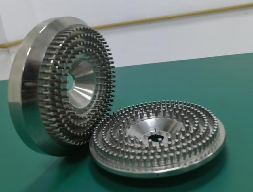
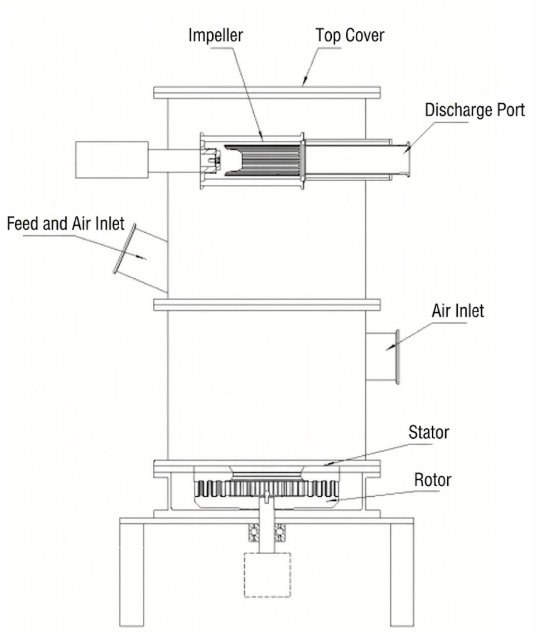
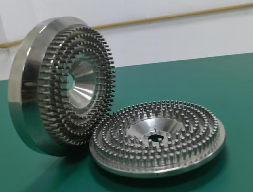
Both series share the same pin mill crushing core. A high-speed rotor disc turns against a fixed stator disc inside a sealed chamber; feed enters at the center and is drawn in by negative pressure. Pin tip speed increases from the inner row to the outer row, so particles are crushed progressively finer by impact, shear, and friction, then struck again on the chamber-wall impact ring.
==
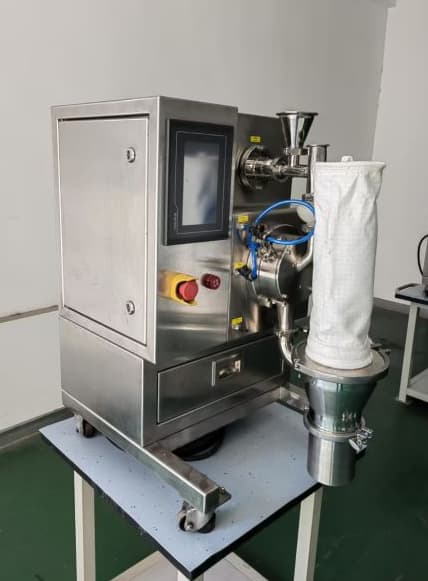
PM Series
In the horizontal PM, crushed powder discharges radially by centrifugal force in a single pass — no classifier wheel. Product fineness is set by rotor speed and feed rate, which keeps the machine simple to clean and fast to turn around between lab samples.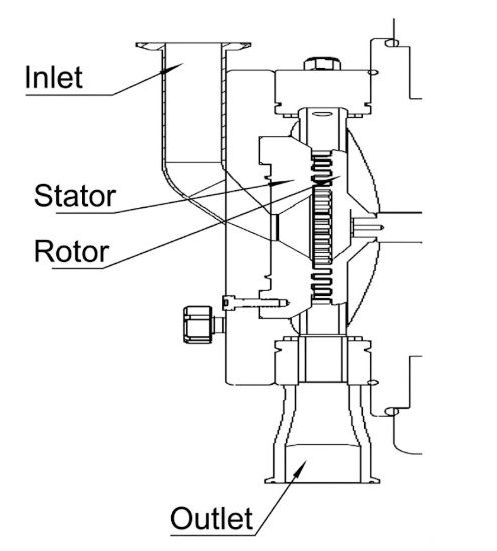
==
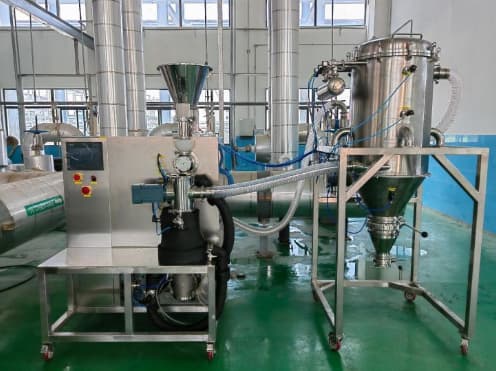
LPMG Series
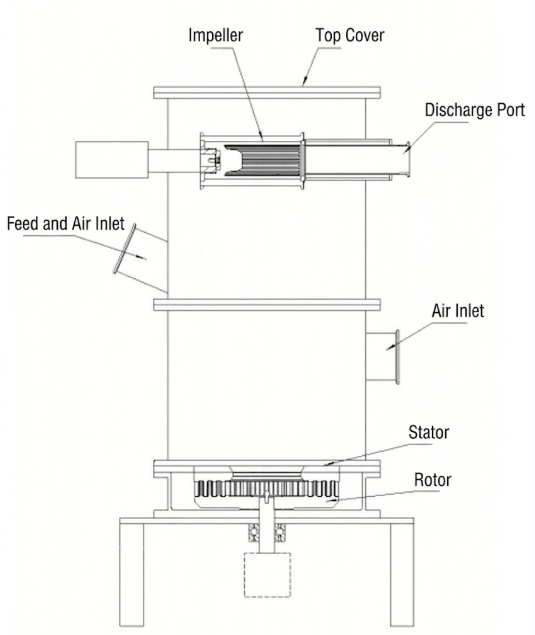
In the vertical LPMG, rising airflow carries crushed powder up to a variable-frequency classifier wheel above the grinding zone. Fine particles pass the wheel into the collector; coarse particles fall back for further grinding. Changing the wheel speed alone changes the cut size, so product D50 is controlled independently of the grinding rotor — from 0.5 to 30 µm.
==
==
PM vs LPMG at a Glance
| PM Series | LPMG Series | |
|---|---|---|
| Orientation | Horizontal | Vertical |
| Classifier wheel | None — single-pass radial discharge | Yes — VFD cut-size control, coarse recirculation |
| Product D50 | 3–20 µm | 0.5–30 µm |
| Scale | Lab, 0.1–10 kg/h | Pilot to production, 1–400 kg/h |
| Cryogenic option | — | Inlet gas to -80°C, no liquid nitrogen |
| Atmosphere | Air | Air or closed-loop N₂ with O₂ monitoring |
| Typical role | Feasibility trials, sample prep | Scale-up and continuous production |
Key Features
- Media-free impact grinding — no bead or ball contamination in the product
- Same pin-disc geometry across both series — lab results on PM transfer directly to LPMG scale-up
- Classifier wheel on LPMG cuts D50 anywhere from 0.5 to 30 µm without hardware changes
- Cryogenic module supplies -80°C inlet gas by mechanical refrigeration — no liquid nitrogen consumption
- Closed-loop nitrogen circuit with on-line oxygen monitoring for oxidation-sensitive or combustible powders
- 316L stainless contact parts, GMP-compliant; wear-resistant disc options including TC4 titanium alloy
Experiment Results
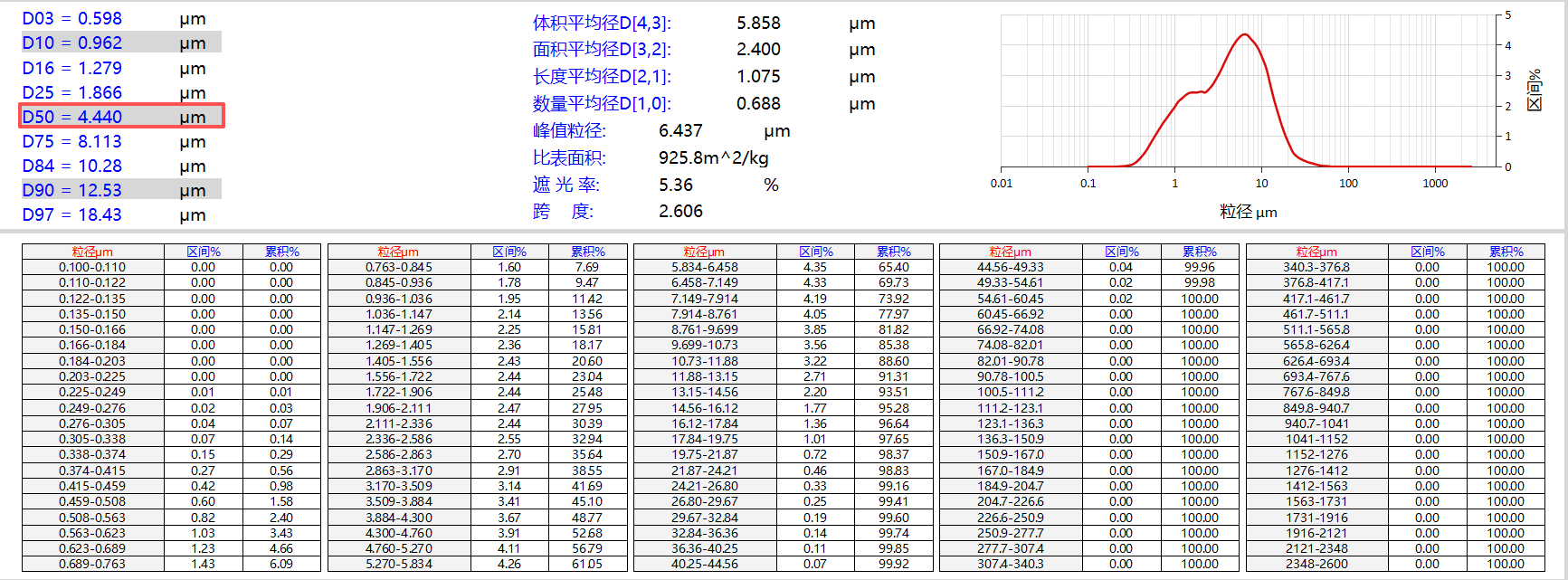
Ferrous Oxalate (Sodium-Ion Battery Precursor) Grinding — PM-50
Feed: ferrous oxalate precursor powder for sodium-ion cathode synthesis.
Result: single-pass D50 = 4.44 µm, D90 = 12.53 µm, D97 = 18.43 µm.
==
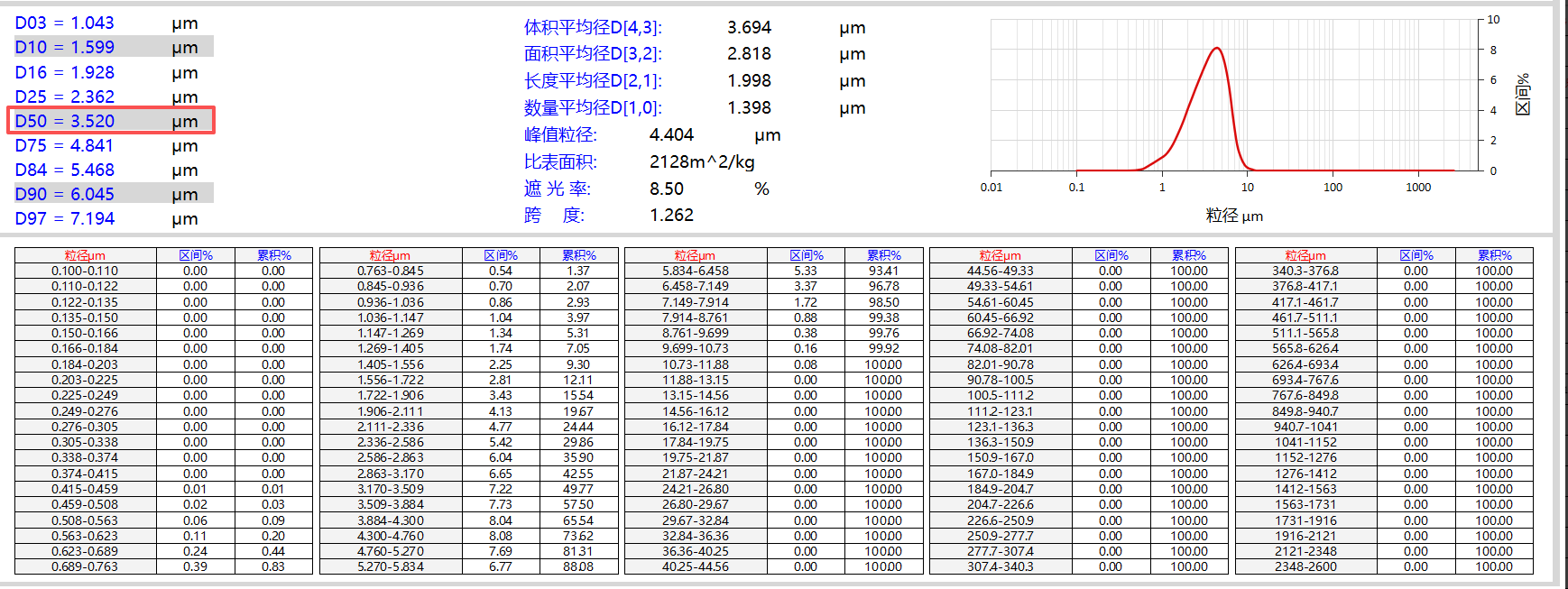
Porous Carbon Grinding — PM-50
Feed: petroleum-coke-based porous carbon.
Result: D50 = 3.52 µm, D90 = 6.05 µm, D97 = 7.19 µm, span 1.26 — a narrow, unimodal distribution.
==
Selected Verified Results Across the Series
| Material | Machine | Feed D50 | Product D50 | Product D97 | Condition |
|---|---|---|---|---|---|
| Lithium iron phosphate | PM-50 | 10.72 µm | 0.77 µm | 3.77 µm | Ambient |
| Titanium dioxide | PM-50 | 103.7 µm | 0.815 µm | 9.10 µm | Ambient |
| Lithium iron phosphate | LPMG-100 | 10.72 µm | 0.804 µm | 2.51 µm | Ambient |
| Solid electrolyte | LPMG-160 | 48.96 µm | 1.349 µm | 3.98 µm | Cryogenic, N₂ |
| Lithium sulfide | LPMG-160 | 3.454 µm | 0.886 µm | 2.53 µm | Cryogenic, N₂ |
| Toner | LPMG-160 | 219 µm | 10.94 µm | 21.13 µm | Cryogenic |
Applications
- Lithium battery cathode materials — LFP and cobalt oxide ultrafine grinding to submicron D50
- Sodium-ion battery precursors — ferrous oxalate, sulfates, and organic precursors at lab scale
- Carbon materials — porous carbon and hard carbon milling with narrow span control
- Solid-state electrolytes — sulfide electrolytes ground under closed-loop nitrogen at -80°C
- Pharmaceuticals and food powders — GMP-compliant contact parts; cryogenic grinding for heat-sensitive materials
- Non-metallic minerals and ceramics — calcium carbonate, alumina, and titanium dioxide fine grinding
Enquiry
Tell us your material, target particle size, and throughput. We will advise on
model selection and run a trial on your own powder before you commit to equipment.
Yibin Andy Wei — Application Engineer
Email: [email protected]
LinkedIn: Yibin Andy Wei
WhatsApp: +1 380 900 2442