
Specifications
VS Series — Centrifugal Mechanofusion
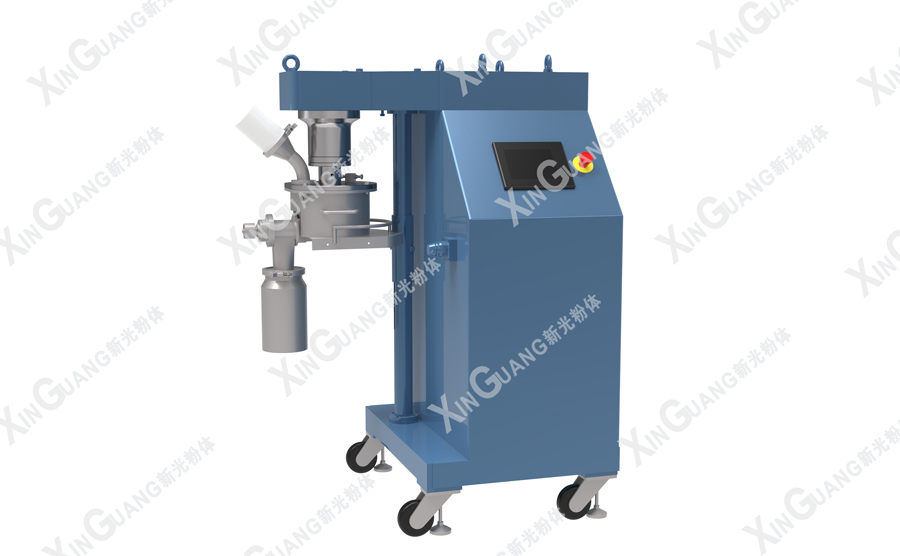
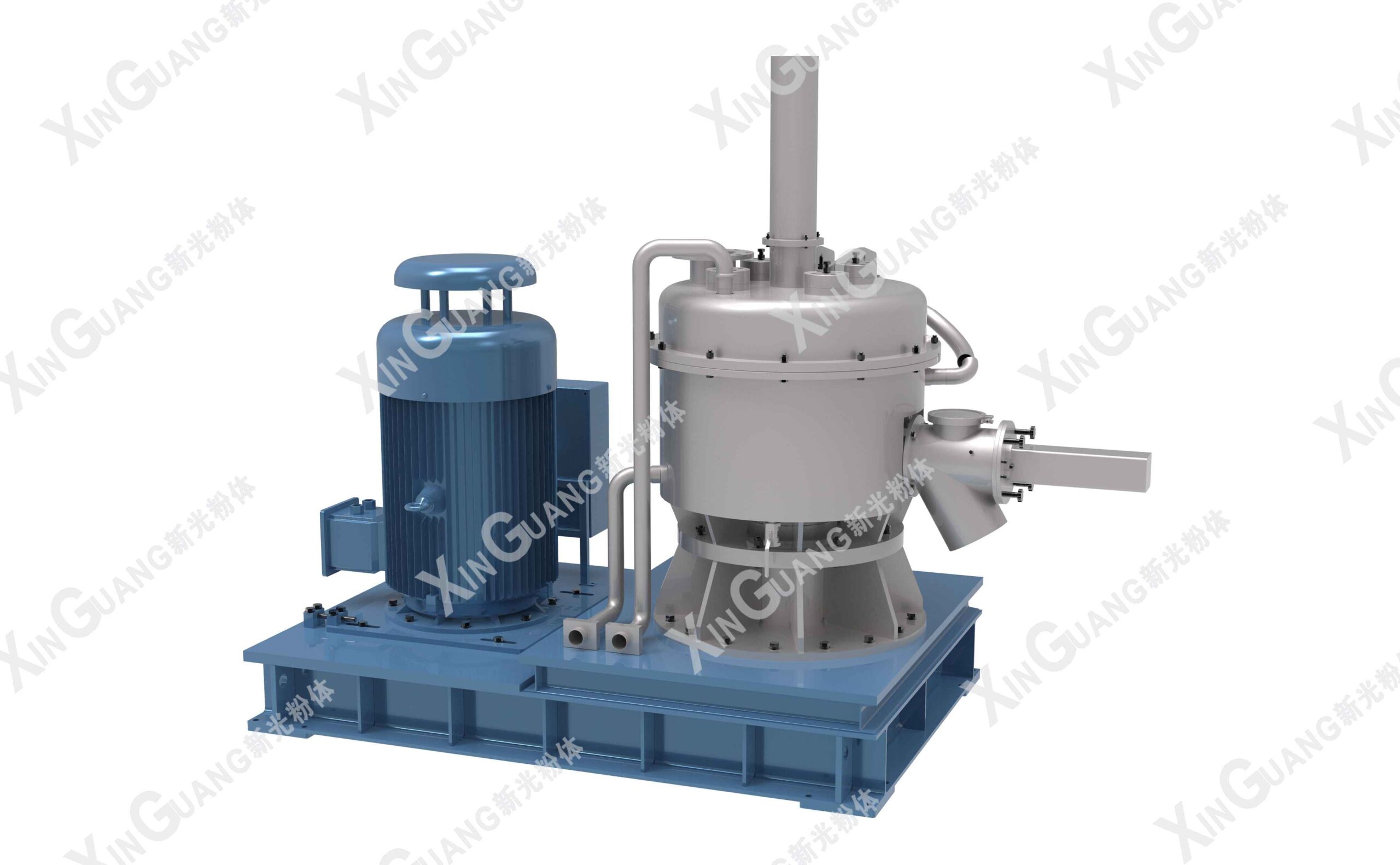
| Model | Scale | Working Capacity (L) | Power (kW) | Tip Speed (m/s) |
|---|---|---|---|---|
| VS-3 | Lab | 0.8–1.2 | 2.2 | 20 |
| VS-300 | Production | ≤25 | 30 | 27 |
| VS-600 | Production | ≤80 | 75 | 33 |
| VS-1000 | Production | ≤100 | 110 | 30 |
Operating Principle
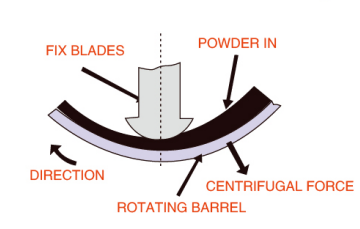
A high-speed rotor spins inside a cylindrical chamber, driving powder outward by centrifugal force against the chamber wall. A stationary cylindrical fusion head positioned at the working gap applies compression and shear forces to each particle as it passes through.
Slits in the rotor wall allow processed material to pass outward; external shovels then recirculate the powder back into the rotor inlet, creating a continuous processing loop. A water-cooling jacket maintains chamber temperature throughout the cycle.
The sealed, solvent-free environment ensures that surface modification, coating, and tap density enhancement are achieved entirely through mechanical force — no liquid carrier or thermal input required.
Key Features
- Tip speeds up to 33 m/s deliver consistent compression and shear at the working gap across all batch sizes.
- Discharge residue confirmed below 0.5% under standard operating conditions — verified on VS-1000 with 40 kg graphite batches.
- Water-cooling jacket maintains stable chamber temperature without external temperature control equipment.
- Sealed chamber design eliminates solvent, binder, and thermal treatment steps from the modification process.
- Scale-up from 0.8 L lab unit to 100 L production unit with consistent mechanofusion mechanism across all models.
Experiment Results
Case 1: Material Residue Verification — VS-1000
VS-1000 processed artificial graphite (tap density 0.4 g/cm³) at 651 rpm and 40 kg per batch across 3-minute and 5-minute cycle times. Discharge recovery reached 39.6–39.9 kg per batch — material residue confirmed below 0.5% under normal operating conditions.
Case 2: Graphite Surface Modification — Low-Temperature EIS
VS-processed graphite (SG-Y) showed a 43% reduction in SEI film resistance (RSEI: 10.89 Ω vs 19.05 Ω) and a 45% reduction in charge-transfer resistance (RCT: 424.7 Ω vs 767.7 Ω) against unprocessed graphite (SG-N) in EIS testing at −30°C, 60% SOC.
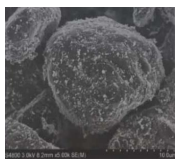
Case 3: Lithium Battery Applications — Anode and Cathode Composite
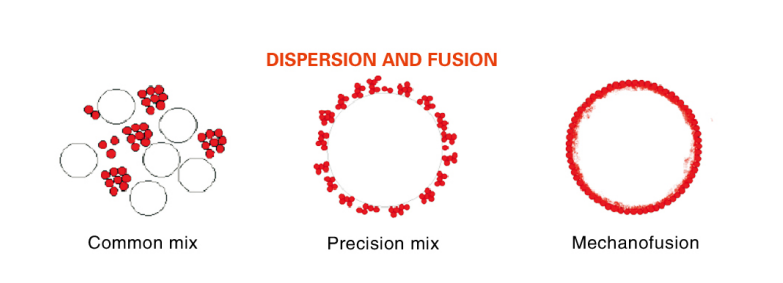
Cathode composite: Active cathode particles composited with acetylene black via VS mechanofusion show a continuous, embedded carbon layer under SEM. Ordinary blending produces loose agglomerates; other fusion methods leave incomplete surface coverage.
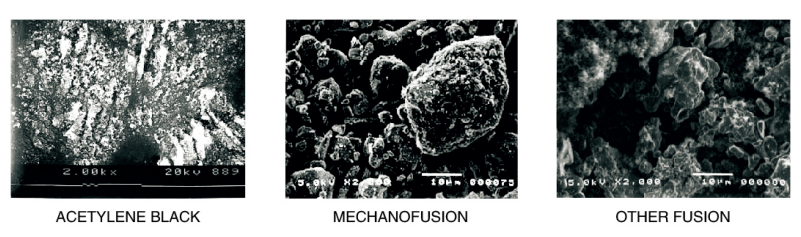
LIB applications — anode and cathode composite (acetylene black / VS mechanofusion / other fusion)
Applications
- Lithium Battery Anode
Graphite spheroidization, tap density enhancement, and carbon layer embedding for artificial and natural graphite. - Lithium Battery Cathode
Dry compositing of active material with conductive carbon (acetylene black, carbon nanotube) without solvent or binder. - Magnetic Materials
Ceramic powder coating on spherical magnetic particles for improved surface insulation and flow properties. - Electronic Materials
Surface modification of metal powders and composite powders for uniform particle morphology and improved packing density. - Specialty Ceramics
Dry fusion of fine ceramic particles onto carrier powders for controlled surface composition.
Enquiry
Tell us your material, target particle size, and throughput. We will advise on
model selection and run a trial on your own powder before you commit to equipment.
Yibin Andy Wei — Application Engineer
Email: [email protected]
LinkedIn: Yibin Andy Wei
WhatsApp: +1 380 900 2442